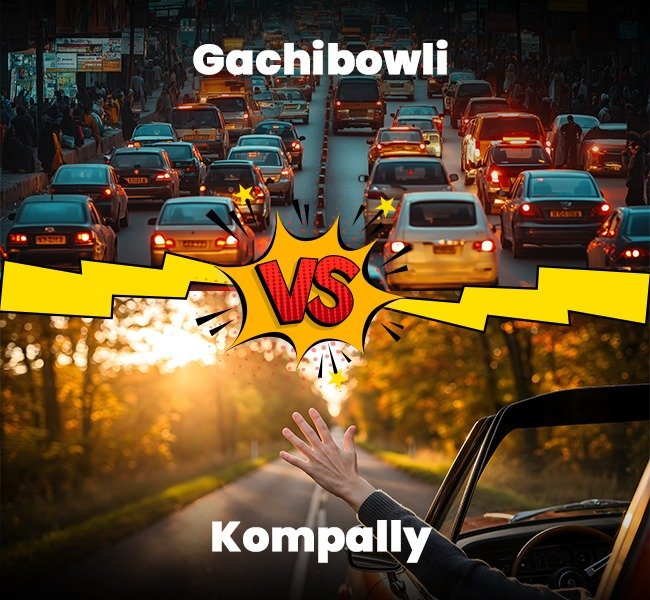
Kompally vs Gachibowli: where to invest?
1. Connectivity and Physical Access
Gachibowli:
- Located closer to the IT hubs of Hyderabad
- Excellent connectivity via the ORR and main city arteries
- Easy access to HITEC City, Financial District, and major corporate zones
- Shorter commute times for professionals working in tech and corporate sectors
Kompally:
- Connected via NH-44 and ORR linkage routes
- Offers easier access to northern and peripheral zones
- Commute distances to core corporate areas are longer than from Gachibowli
- Less congestion for daily travel compared to inner city hubs
Verdict:
Gachibowli offers proximity to jobs and shorter commutes, while Kompally offers ease of movement and lower traffic exposure — both important for investment evaluation.
2. Infrastructure Presence vs Future Potential
Gachibowli:
- Highly mature infrastructure
- Established civic utilities
- Metro connectivity on the horizon
- Developed social ecosystem (schools, hospitals, entertainment)
Kompally:
- Evolving infrastructure
- Road access and civic utilities improving over time
- Balanced environment with lower density
- Increasing connectivity as expansion continues
Verdict:
Gachibowli wins in present infrastructure, while Kompally shows potential for organic future infrastructure growth.
3. Economic and Employment Ecosystem
Gachibowli:
- Heart of Hyderabad’s IT economy
- Major companies, global tech campuses, and corporate centers
- High demand from job-linked homebuyers and rentals
- Strong rental yields due to steady corporate demand
Kompally:
- Not a direct employment hub
- Appeals more to families and working individuals with flexible commute patterns
- End-user demand is residential, not corporate
Verdict:
From a pure job-linked investment metric, Gachibowli tends to lead due to direct corporate proximity.
4. Property Price Dynamics and Investment Expectations
Gachibowli:
- Higher average price per sq. ft.
- Premium segment dominance
- Stronger short-term demand from professionals
- Resale value supported by robust corporate demand
Kompally:
- Lower entry prices compared to Gachibowli
- Wider land availability for planned layouts
- Gradual and stable growth trajectory
- Suitable for systematic long-term investment
Verdict:
Gachibowli performs well for higher short-term returns and rental yield. Kompally shows price stability with a gentler growth curve, appealing for long-term capital appreciation.
5. Livability and Community Environment
Gachibowli:
- Urban lifestyle hub
- High population density
- More commercial activity
- Greater traffic and urban bustle
Kompally:
- Suburban tranquil environment
- Cleaner residential zones
- Wider spaces, disconnect from inner city congestion
- Favored by families and long-term settlers
Verdict:
Kompally appeals more to buyers seeking peaceful residential life, while Gachibowli suits those who want urban vibrancy.
6. Rental Demand and Real Estate Returns
Gachibowli:
- High rental demand due to corporate demand
- Active rental yield markets
- Homes often occupied by professionals and IT employees
Kompally:
- Rental demand exists but is moderate
- Families and long-term tenants are common
- Rental yields are more modest but offer stability